
Skilled Trades vs Traditional Degrees: Which Career Path Offers Better Opportunities?
For many years, students were encouraged to follow a familiar path: graduate from high school, attend university, earn a degree, and build a successful career.
While that path continues to be the right choice for many professions, today’s job market offers more options than ever before. Skilled trades are experiencing strong demand across Ontario, and many students are discovering that a trades career can provide excellent income potential, job security, and faster entry into the workforce.
The question is no longer whether one path is better than the other. The real question is which path best matches your goals, interests, and career aspirations.
At the same time, demand for Skilled Trade Ontario professionals is outpacing supply. Employers are struggling to fill positions. Wages in the trades are strong. And more students are starting to ask whether a trades path might actually serve them better than four years at university. That question deserves an honest answer.
The Degree Was Supposed to Be the Safe Choice
For decades, a university degree was treated as the one guaranteed path to success. Go to school. Get a degree. Get a good job. That was the formula.
But the formula has cracked.
Many degree holders work in jobs that never required a degree in the first place. The return on a four-year investment is far less predictable than it used to be. Meanwhile, skilled trade employers across Ontario are reporting some of the highest vacancy rates they have seen in years.
The safe choice is looking less safe. And the path that was once considered a backup is now looking like a very smart move.
Earning Well Without Starting in Debt
One of the biggest advantages of the trades path is financial. Not just in terms of what you eventually earn, but in terms of what you avoid spending to get there.
University students often spend four or more years paying tuition, living costs, and accumulating loans before they land their first job in their field. Trades students typically complete training in a fraction of that time and enter the workforce much sooner.
The best paying skilled trade jobs are not just competitive with degree salaries. In many cases, they exceed them, especially when you factor in that tradespeople start earning sooner and carry far less debt going in
What About Job Security? This is where trades really separate themselves from many degree paths.
Canada faces a skilled labour shortage that is not going away. An estimated wave of experienced tradespeople is approaching retirement across the country. The pipelines replacing them are not full. That creates long-term demand and job security that very few industries can match.
Modern manufacturing careers involve far more than manual labour. Today’s skilled workers regularly use:
-
CNC machines
-
CAD/CAM software
-
Automation systems
-
Digital blueprints
-
Precision measuring equipment
-
Advanced manufacturing technologies
As technology continues to evolve, employers increasingly seek workers who can combine technical knowledge with practical skills.
Many degree-based careers face growing disruption from automation and AI. Trades that involve technical problem-solving and CNC machine operation are proving far more resilient to those same forces.
Modern Manufacturing Careers Are Highly Technical
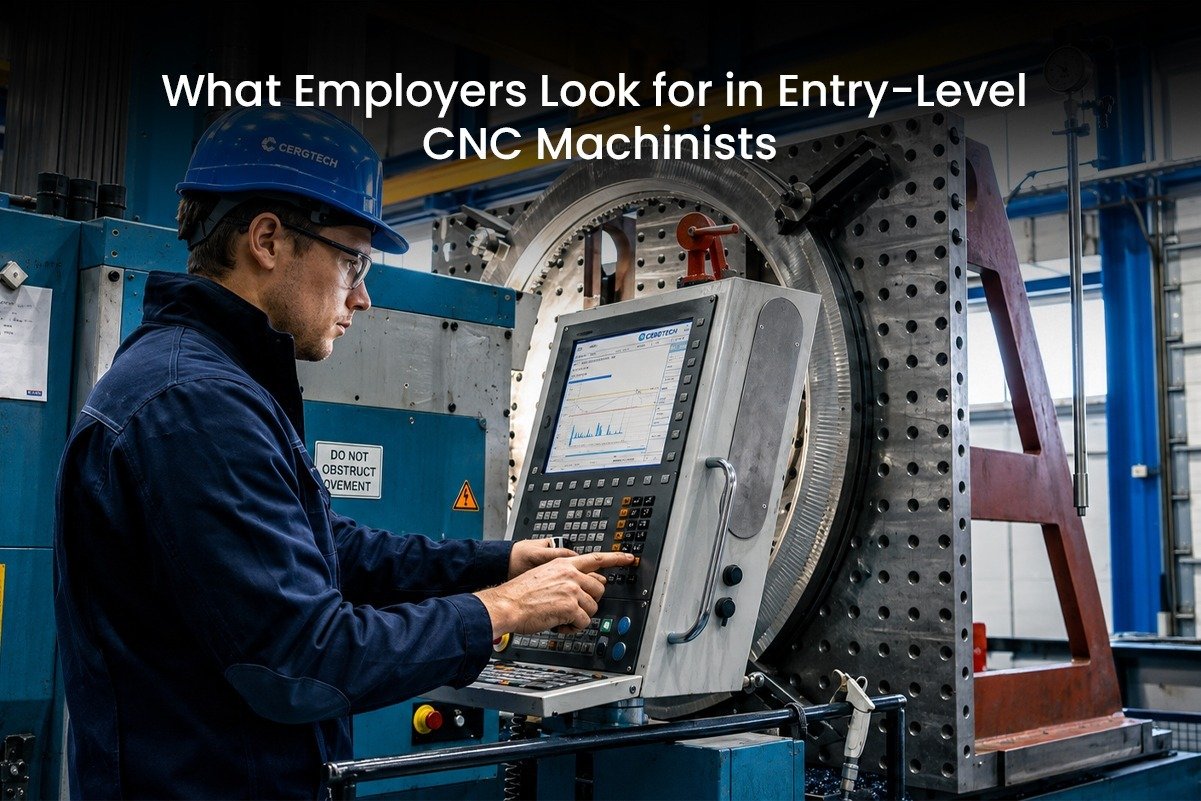
Many people still have outdated perceptions of manufacturing and skilled trades. Modern CNC operators and programmers work with advanced software and precision equipment to manufacture components used in industries such as aerospace, automotive, medical devices, and industrial machinery.
These professionals may:
-
Program CNC machines using G-code and M-code
-
Create machining strategies using Mastercam
-
Interpret engineering drawings and blueprints
-
Work with CAD models created in SolidWorks
-
Perform quality inspections and precision measurements
-
Troubleshoot production issues
This combination of technology and hands-on work makes manufacturing careers appealing to individuals who enjoy both technical and practical challenges.
Modern trades careers involve digital technology, precision engineering, and complex problem-solving. Consider what a CNC role actually looks like today:
- Working with advanced software to program machines that produce components for aerospace, automotive, and medical industries.
- Reading and interpreting engineering drawings with high accuracy.
- Troubleshooting technical issues that require both mechanical knowledge and digital literacy.
- Collaborating with engineers and production teams on tight-tolerance projects.
That is not low-skill work. It is technical, well-compensated, and deeply satisfying for people who enjoy working with their hands and their minds together. The trades have a perception problem. The reality is something quite different.
How Training Programs are Bridging the Gap
At IMTT Canada, we see this shift happening directly through the students who come through our doors. More people are choosing trades training as a deliberate first choice, not a fallback. They have done the research. They understand the opportunity. And they are choosing a path that makes practical sense for their lives.
We offer programs built around employer demand in Ontario. Our students complete courses with hands-on skills, industry-relevant credentials, and the confidence to step into their first role immediately. We stay connected to what employers are actually hiring for so our training stays current and useful.
Programs like ours are also becoming more accessible through government support. Better Jobs Ontario programs exist specifically to help Ontarians upskill and enter high-demand sectors including manufacturing and the skilled trades. Financial support for training removes one of the last remaining barriers between capable people and well-paying careers.
The structure of how people access trades training is improving. Costs are lower. Pathways are clearer. Employer connections are stronger than ever.
Financial Support May Be Available
For many students, cost is an important consideration when choosing a career path.
Eligible individuals may qualify for funding opportunities such as Better Jobs Ontario, which can help cover tuition, books, transportation, and other training-related expenses.
Financial assistance can make career-focused training more accessible and help students transition into high-demand industries faster.
So Which Path Is Actually Better?
The answer depends on the person, the career goal, and the kind of future they want to build.
If your goal is to become a doctor, lawyer, or engineer, then a university degree is essential. Those careers require that path, and for many people, it is the right investment.
But for students who want a practical career, strong earning potential, job stability, and the opportunity to enter the workforce sooner without carrying years of debt, the skilled trades offer a powerful alternative.
Today, more people are beginning to realize that trades are not a “backup plan.” They are a respected and rewarding career path with real long-term opportunities.
At IMTT Canada, we have seen students transform their lives through hands-on training and industry-focused education. Many have gone on to build stable careers, support their families, and grow with confidence in an industry that continues to need skilled professionals.
The best career path is not about following trends or expectations. It is about choosing a future that aligns with your strengths, interests, and goals.
If you are exploring a career in manufacturing, CNC machining, or skilled trades, connect with the IMTT Canada team to learn how our programs can help you get started. Book a consultation with our team to learn more about our programs.