AI Automation vs. Skilled Trades: Why CNC Operators Remain Essential
Automation sparks the same debate. Which jobs are safe? CNC machining always comes up early. Factories are adding robots. AI is writing code. Software is doing tasks that used to take years to learn.
Yet demand for skilled CNC operators keeps growing. Ontario manufacturers are hiring, and many shops cannot fill positions fast enough. The numbers tell a different story than the headlines.
Understanding why CNC operators still matter means looking at what automation actually does—and where it falls short. Human skills remain essential every day on the shop floor.
What Does AI Automation Do in Manufacturing?
AI has changed how factories operate across Ontario and around the world. It takes over repetitive tasks and helps shops run faster with fewer errors.
These are real gains. But they do not tell the whole story of what happens on the shop floor every shift.
Here is what AI handles in a modern manufacturing environment:
- Routine programming: AI-assisted CAM software can automate portions of toolpath generation. Work that once took a senior programmer hours now happens much faster.
- Machine monitoring: AI-powered monitoring systems can track equipment in real time and flags issues before they cause breakdowns. This keeps production on schedule.
- Maintenance prediction: Systems analyze machine data and alert teams before parts fail. Shops avoid costly production stops.
- Error detection: AI quality tools catch defects faster than manual inspection. They reduce scrap and speed up quality checks.
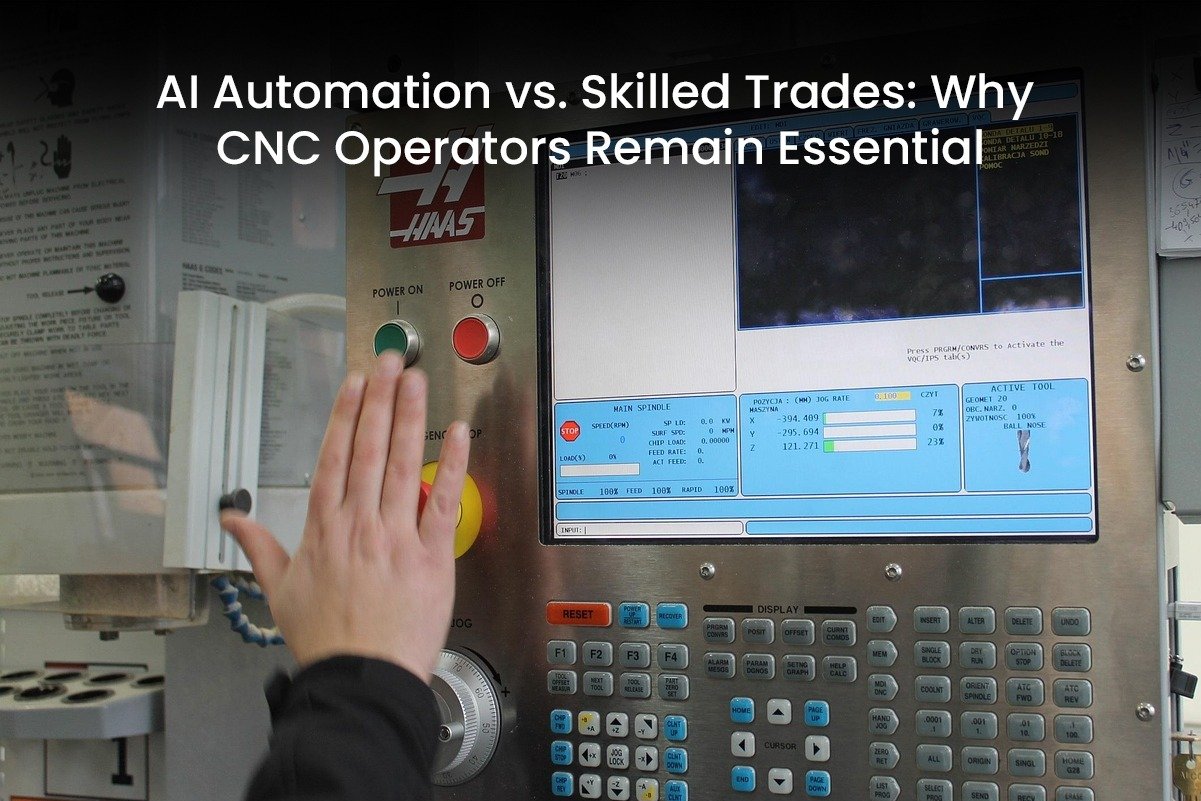
But automating a task is not the same as replacing the person who oversees it. AI generates toolpaths. It does not feel a vibration in the spindle or catch a workpiece that is slightly off before the first cut. That judgment still belongs to the machinist at the machine. Human operators still validate, optimize, and safely execute those programs.
Why CNC Operators Still Cannot Be Replaced
The shop floor is full of variables. Materials behave differently. Tools wear unevenly. Fixtures shift. Many of these challenges cannot be solved by software alone. They need real-time human response.
Employers increasingly need CNC operators who can program and troubleshoot equipment, not just run it. This has narrowed the qualified candidate pool and increased demand for experienced CNC professionals, especially for operators with multi-axis and CAM software experience.
Here is what skilled operators bring that automation cannot replicate:
- Reading machine behavior in real time: An experienced operator hears when a cut sounds wrong. They adjust before a part gets ruined. That sensory feedback cannot be coded into a system.
- Handling custom jobs: One-off parts and complex setups often fall outside what automated programming handles well. The operator’s ability to adapt keeps the shop moving.
- Bridging design and machine: Drawings do not always account for real-world material behavior. Operators catch those gaps early before they become costly mistakes.
These skills make CNC machinists among the most in-demand skilled trades in Ontario.
The Talent Gap Is Getting Wider, Not Smaller
In the trades sector, 700,000 skilled workers are projected to retire between 2019 and 2028 across Canada, according to federal government data. Ontario is expected to experience significant demand as part of this nationwide labour shortage.
Retirements are accelerating across the skilled trades, creating vacancies that apprenticeship pipelines are not filling fast enough. Shops are not cutting CNC jobs because of AI. Many are struggling to keep machines staffed at all.
So What Does This Mean for Someone Entering the Trade?
The timing is good. The shortage is structural, not temporary. Anyone entering CNC machining today steps into a market that continues to demand skilled professionals who can earn competitive wages for the right skills. That demand is not going away. It is growing.
How Training Shapes the Modern CNC Career
Today’s CNC operator does far more than press start. They work with CAD/CAM software, read technical drawings, manage tight tolerances, and handle quality checks daily. The role is more technical now, which also means it pays better.
Pursuing a quality CNC machine course gives students a foundation covering both the practical and technical sides of the trade. Ontario employers want operators who can contribute from day one.
At IMTT Canada, we train students on real CNC mills, lathes, and CAM software in a hands-on workshop in Mississauga. Our programs reflect what manufacturers actually need on the floor. Students graduate with practical experience operating, programming, and troubleshooting modern CNC equipment.
Is CNC Among the Highest-Paid Trade Skills in Ontario?
Entry-level CNC operators earn competitive wages. Operators who add programming and multi-axis experience move into a higher pay bracket quickly.
Wages for skilled trade positions in Ontario have increased notably year over year, reflecting how strongly employers are competing for talent. CNC ranks consistently among the highest paid trade skills in manufacturing, particularly in aerospace, automotive, and medical device production.
The career path is flexible, too. Many CNC operators advance into programming roles, quality control, or shop supervision over time. Each step brings better pay and more responsibility.
Automation Makes Good Operators More Valuable, Not Less
Automation handles volume and repetition. It speeds up routine work. But it raises the bar for what operators need to know to work alongside those systems.
At IMTT Canada, students step into shops running advanced software and automated equipment. Our training covers Mastercam and SolidWorks alongside hands-on machine time. Graduates understand the full workflow from design to finished part.
A career built on a skilled trade that Ontario employers continue to value is rooted in adaptable, hands-on expertise. Automation is not shrinking this trade. It is making the skilled people inside it more important than ever.
Want to learn more about our programs? You can contact our team at 905‑908‑2355
or book a consultation to learn more.