The Rise of Smart Manufacturing in Ontario: Why CNC Skills Matter More Than Ever
Ontario’s manufacturing sector is changing fast. The skills employers want today look very different from what they needed five years ago. Students entering manufacturing today have access to advanced technologies, automation systems, and high-demand career opportunities that did not exist a decade ago.
Most people still picture manufacturing as loud, repetitive, and low-skill. That picture is outdated. Technologies such as CNC machines, industrial robotics, CAD/CAM software, automated inspection systems, and real-time production monitoring are now common across Ontario manufacturing facilities.
Students who understand this shift will find doors opening for them. Students who do not will find those same doors harder to reach. The difference usually comes down to where and how they trained.
Smart Manufacturing Is Already Happening Across Ontario
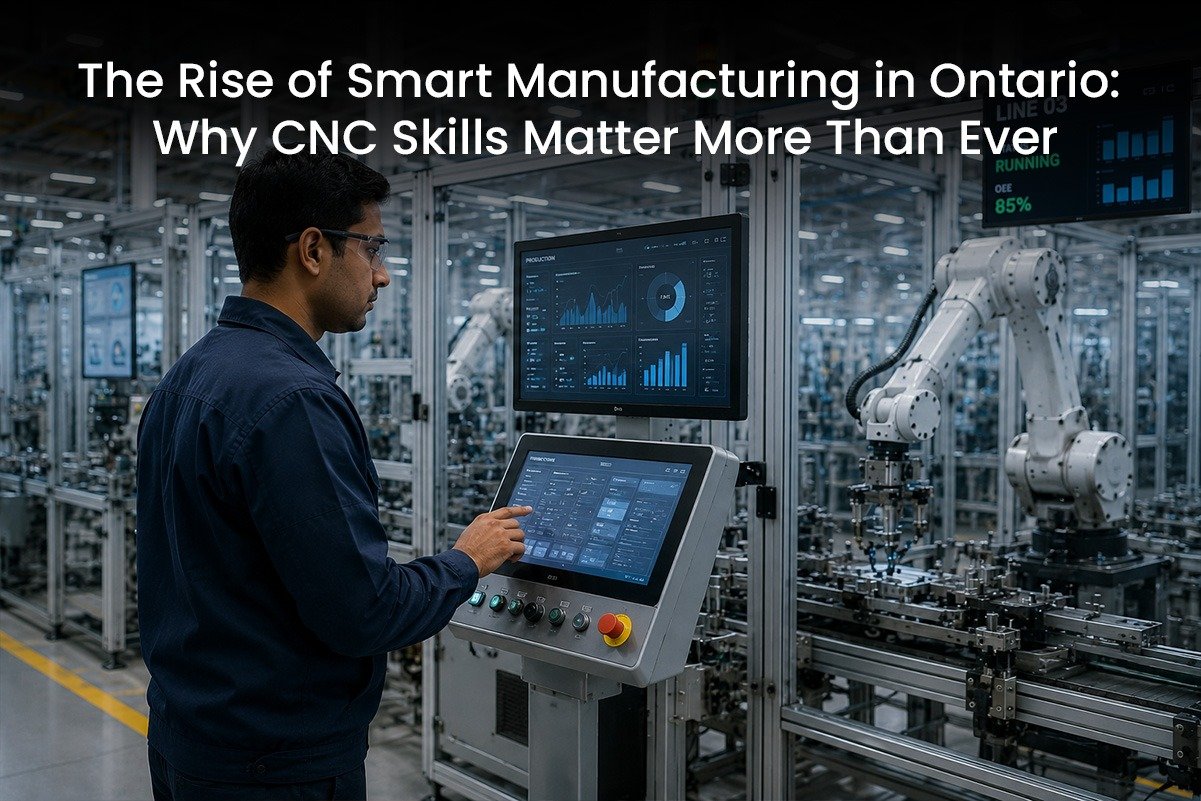
Step into a modern Ontario manufacturing facility and you will see something different from what most people imagine. Automated systems run alongside skilled workers. Software controls output with precision. Data moves through the facility in real time.
Smart manufacturing brings together connected technology, automation, and data to improve how products are made. Ontario manufacturers are adopting these tools quickly, and they need workers who understand how to use them.
What Is Driving This Change
Two things are pushing Ontario manufacturers toward smarter operations faster than anything else.
The first is a workforce gap. Experienced workers are retiring across the province. Manufacturers are investing in automation to maintain output while they search for trained people to fill the roles left behind.
The second is competition. Canadian manufacturers compete globally. Technology helps them stay efficient and deliver higher-quality work at competitive costs. That investment in technology does not reduce the need for skilled people. It changes what skilled people need to know.
The Gap Between What Employers Need and What Graduates Offer
Employers across Ontario are not just asking for better candidates. Many are leaving positions unfilled because the right candidates are not available yet.
Employers across Ontario are increasingly seeking skilled trades professionals who understand modern manufacturing technologies. They want someone who can read digital outputs and respond when something goes wrong. They want experience in a skilled trade Ontario and understanding of the technology behind the machines.
That gap between employer expectations and graduate readiness is wide right now. For students who train with the right focus, that gap is an opportunity.
So What Does This Mean for Students Considering Manufacturing?
The timing has never been better for students who are willing to build the right skills. Manufacturing careers now offer strong salaries, job stability, and room to grow. Many other sectors cannot say the same right now.
The key is training that matches where the industry is going today, not where it was ten years ago. Students need programs that combine hands-on practice with exposure to the tools and systems that modern manufacturers depend on.
- Automation literacy: Understanding how automated systems work and how to operate them confidently. It is now a baseline expectation at many Ontario facilities.
- Programming skills: The ability to read, write, and edit machine programs is growing in value across production environments. Facilities are running more complex parts and they need people who understand the programming side of that process.
- Digital design knowledge: Workers who can read CAD files and understand 3D models communicate better with engineering teams. The connection between the design office and the production floor has never been closer.
- Problem-solving under pressure: Modern production systems generate a lot of data. When something flags an issue, workers need to think clearly and act quickly. Employers actively look for this quality in candidates.
Students who develop these skills alongside trade fundamentals will stand out in any hiring process. The combination is exactly what the market is asking for.
Employers are not looking for people to simply watch machines run. They are looking for people who can take ownership of what those machines produce. That takes proper training and hands-on practice.
How IMTT Canada Is Preparing Students for This Industry
At IMTT Canada, we built our programs around what Ontario employers are actually hiring for today. We stay close to industry trends and we design our courses to reflect where the work is going, not where it has been.
Students receive practical training in:
-
CNC machine operation and setup
-
G-code and M-code programming
-
Blueprint reading
-
SolidWorks CAD software
-
Mastercam CAM software
-
Precision measurement and inspection
Students in our CNC Machine Tool Operator & Programmer Diploma Program complete more than 500 hours of hands-on workshop training and work on real machining projects that help prepare them for industry.
Programs That Connect Training to Employer Demand
Our CNC machine course gives students direct access to one of the most in-demand skill sets in Ontario manufacturing today. CNC technology sits at the centre of precision production across aerospace, automotive, medical devices, and industrial manufacturing.
Graduates with CNC training may pursue careers such as:
-
CNC Operator
-
CNC Setup Technician
-
CNC Programmer
-
Manufacturing Technician
-
Quality Control Technician
These roles can be found in industries including aerospace, automotive, medical device manufacturing, industrial equipment, and precision machining.
The CNC Computer Programmer Path
The CNC computer programmer role includes CNC machine setup, G-/M-code programming and blueprint interpretation. These professionals take engineering drawings and turn them into machine instructions that produce parts at tight tolerances.
Demand for this role is growing across Ontario. As manufacturers invest in more capable equipment, they need people who can program it effectively. Experienced programmers earn well above the trade average, and the career path offers strong long-term growth.
At IMTT Canada, we prepare students for this path by teaching programming alongside machine operation so graduates understand both sides of the manufacturing process.
This combination positions graduates for roles with strong starting pay and a clear path forward. Manufacturing rewards people who can take on more responsibility, and programming knowledge is one of the most direct ways to demonstrate that readiness.
Is a Manufacturing Career Worth Pursuing Right Now?
Yes, and the numbers support it. Ontario’s manufacturing sector contributes over 11 percent of provincial GDP. Skilled trades consistently appear among the top shortage occupations across Canada. Employers are competing for qualified graduates.
The opportunity in Ontario manufacturing is clear. Employer demand is strong. What connects students to that demand is the right preparation.Smart manufacturing in Ontario is not something to observe from the outside. It is something to step into, trained and ready to contribute from day one.Students who develop CNC, CAD/CAM, and manufacturing skills today will be well-positioned for rewarding careers in a growing industry.
If you’re interested in building a future in manufacturing, IMTT Canada can help you develop the practical skills employers are looking for.